Relational capital
Trust, accountability, reciprocity, and the relationships that allow people to act together.
Community Investment
Rematriation Stewardship is a way of rebuilding community by returning care, decision-making, ownership, knowledge, and resources to the relationships that can carry them forward.
The responsibility remains
What rematriation stewardship means
Every generation receives new responsibilities. Rematriation Stewardship carries forward the teachings that help people respond to the challenges of their own time: relationship, reciprocity, courage, responsibility, care for place, and responsibility to those yet to come.
It asks us to move away from systems that separate people from land, work from culture, housing from community, and wealth from responsibility. It begins from a different understanding: nothing exists alone. People, family, community, land, water, food, work, culture, and future generations are connected.
Stewardship is therefore more than conservation. It is the practice of becoming a good relative—to people, place, resources, institutions, and generations. Ownership matters because responsibility is difficult to carry when decisions are always made somewhere else.
We do not hold land simply to possess it. We hold responsibility for what the land, the people, and the next generation need from us.
Rematriation economics
Rematriation economics restores care, reciprocity, and collective responsibility as drivers of development. Financial capital matters—but so do trust, relationships, cultural knowledge, healthy land, skilled people, community ownership, and the ability to make decisions locally.
Trust, accountability, reciprocity, and the relationships that allow people to act together.
Knowledge, identity, language, ceremony, teachings, and ways of understanding responsibility.
Skills, purpose, confidence, mentorship, leadership, and the ability to teach the next person.
Healthy land, water, buffalo, habitat, food systems, and the living systems that sustain community.
Housing, businesses, gathering places, infrastructure, local institutions, and community-owned assets.
Revenue, investment, credit, philanthropy, and earned income used to strengthen—not extract from—the whole.
In extractive systems, value leaves the community.
In rematriation economics, value circulates: revenue becomes wages, skills, food, housing, land stewardship, new enterprises, leadership, and opportunity for the next generation.
Stewardship in practice
Land is cared for as a living relationship rather than treated only as an asset. Buffalo, water, soil, habitat, food, learning, ceremony, and future generations become part of the same decision.
Housing is more than units. Community-rooted ownership creates the possibility for stability, accountability, gardens, safety, relationship, and reinvestment in the neighborhood.
Employment is not the destination. Enterprises become classrooms where people learn skills, responsibility, leadership, financial confidence, culture, and how to teach others.
Food connects land, animals, labor, culture, health, family, ceremony, commerce, and care. Local food systems return both nourishment and economic value to community.
The measure of a good investment is not only what it produces today, but what it leaves in the hands of the community tomorrow.
Community investment
Community investment asks a different question than conventional development: not simply, “What did the money buy?” but “What capacity, ownership, relationships, opportunity, and responsibility remain after the investment has been made?”
Rematriation Stewardship treats community investment as the deliberate strengthening of the assets a community needs to determine its own future—people, land, housing, food systems, businesses, skills, gathering places, leadership, culture, and relationships.
Good investment circulates. It creates work, develops leaders, strengthens local ownership, supports families, improves access to food and housing, and leaves the community with greater capacity to make the next decision for itself.
Community development & investment
Experience how community-rooted investment becomes belonging, workforce development, housing, land stewardship, youth opportunity, leadership, and locally owned community assets.
Visit Wambli Ska SocietyFood, workforce & enterprise
See rematriation economics in action through buffalo stewardship, harvesting and processing, workforce pathways, local food access, value-added products, retail, and enterprise.
Visit Sacred Storm Buffalo
Why the magpie
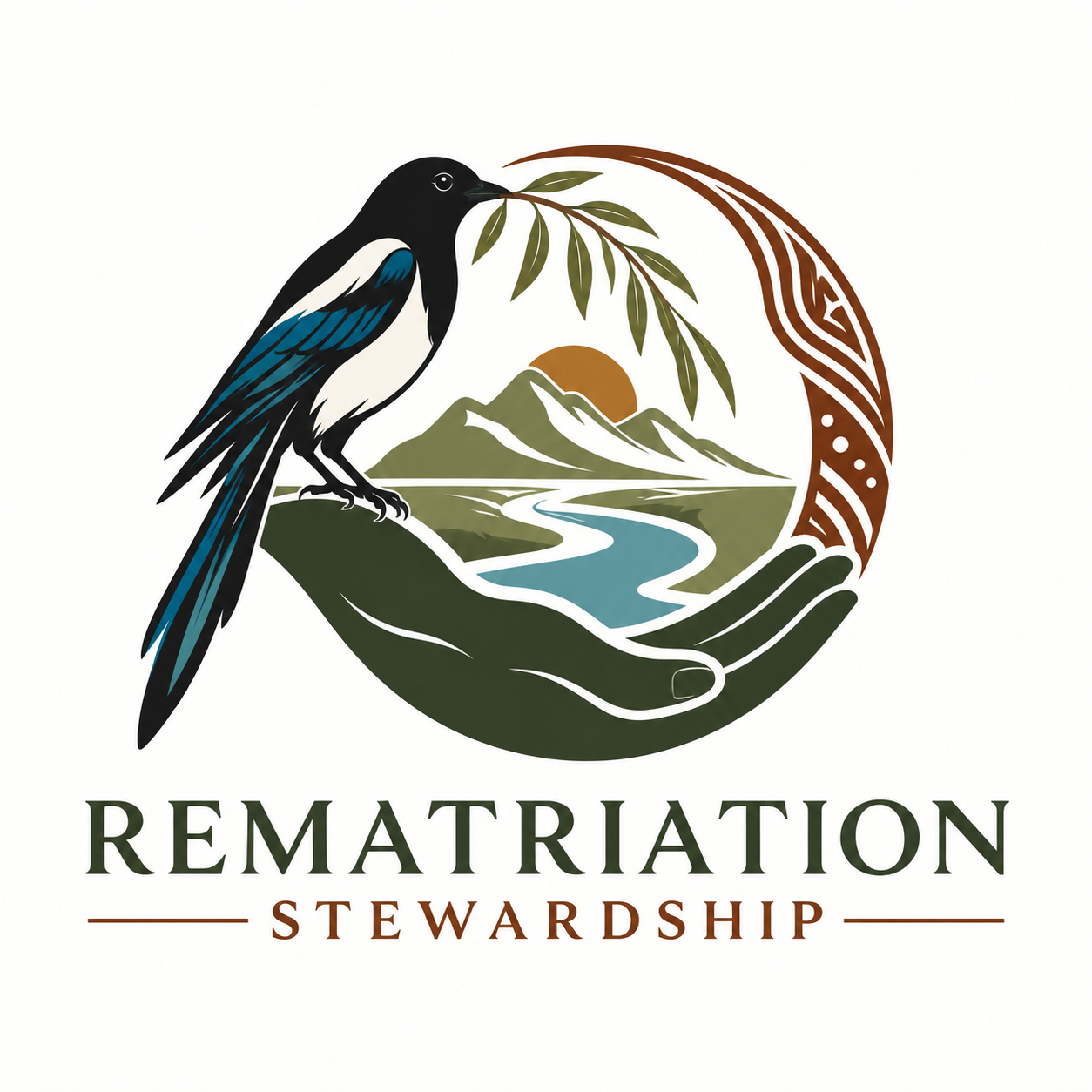
The magpie becomes a companion to this philosophy: observant, adaptable, relational, gathering what is useful and carrying it forward. In our mark, the bird returns with willow while the hand holds land and water—a reminder that renewal is not passive. Someone must notice. Someone must gather. Someone must care. Someone must return what is needed.
The willow speaks to restoration and renewal. The hand speaks to responsibility. The land and water remind us that everything we build is held within a larger living relationship.
The living pattern
This pattern has no fixed beginning or ending. People enter through a meal, a job, a home, a conversation, land, culture, a crisis, a mentor, or a place where they finally know they belong. The relationship grows from there.
What grows from one investment?
Every investment strengthens the next—not because of one organization, but because relationships continue to grow.
An invitation
Rematriation Stewardship is not a program to copy. It is a way to ask better questions: Who holds responsibility? Who makes decisions? Where does value go? What relationships are being strengthened? What remains in the community after the funding ends? What are we preparing for the next generation?
Start a conversation